
Brown County Parole Versus Probation
Parole, postrelease supervision, and probation do not mean the same thing in Kansas. Parole is a discretionary release path used chiefly for eligible older indeterminate sentences. An indeterminate sentence has a minimum and maximum term, and release depends on eligibility plus a decision by the Kansas Prisoner Review Board. Mandatory postrelease supervision generally follows the prison portion of a determinate guideline sentence. Probation is ordered by a judge. It may let a person remain in the community instead of serving a prison term, or it may follow a short local jail sanction.
| Path | Who authorizes it | Best public check |
|---|---|---|
| Parole | Kansas Prisoner Review Board in an eligible case | KASPER status, movement, and assigned parole office |
| Postrelease | Required by the sentence after the prison portion | KASPER supervision type and parole-office record |
| Probation | Sentencing court | Court docket and 22nd Judicial District Community Corrections |
| Final discharge | Responsible authority after obligations are complete | KASPER “Discharged” status or the court/agency discharge record |
A Brown County Jail release does not, by itself, identify one of these paths. A person may bond out with a case still pending, finish a county-jail sentence, transfer into KDOC custody, or return to the community under a court order. Start with the sentencing authority and case record. Then use the state repository only when KDOC custody or funded supervision is involved.
Verify Brown County Release Supervision
The official state search is the Kansas Adult Supervised Population Electronic Repository, or KASPER. It accepts a name or KDOC number and offers advanced filters such as conviction county, supervision county, and supervision type. A Brown County filter can narrow results, but a known person's name and identifiers are safer. Check the current type, movement history, and parole-office assignment together. “Parole” or a postrelease entry shows a community obligation; “Discharged” is stronger evidence that the KDOC obligation has ended.
- Identify whether the case is a state-prison case, a local probation case, or a pending Brown County matter.
- For KDOC custody or supervision, search KASPER and compare the KDOC number, birth date, conviction county, and case details.
- Read the present supervision type, latest movement, and assigned office. Do not rely on an old release date alone.
- For probation, inspect the sentencing docket through the Kansas district-court route and contact 22nd Judicial District Community Corrections.
- Confirm a time-sensitive status with the named office. Data lag, revocation, or a new case can change the result.
KASPER does not cover every Brown County arrest. Someone who bonded out locally and never entered KDOC custody or a KDOC-funded program may have no state repository record. Community-corrections events after April 21, 2021 are also unavailable in the KASPER display during modernization. For that gap, the court docket and direct community-corrections contact are the better sources.
Brown County Supervision Office Split
Brown County has no KDOC parole office within the county. The official KDOC Parole Services directory assigns Brown County to the Atchison Parole Office. That North Region office also serves Atchison, Doniphan, and Nemaha counties. Local felony probation and community corrections use a different office in Hiawatha. Choosing by the legal status, rather than by the nearest address, avoids sending a parole question to a probation office.
State parole and postrelease
KDOC Atchison Parole Office
729 Kansas Avenue
Atchison, KS 66002
913-305-7645
Automated reporting: 866-570-7225
Local probation and community corrections
22nd Judicial District Community Corrections
601 Utah
Hiawatha, KS 66434
785-742-3650, extension 5
Listed contact: Vicki Hubin
The local program covers Brown, Doniphan, Marshall, and Nemaha counties. Before calling, have the person's full name, case number or KDOC number, and the court or agency shown in the record. Published research did not establish public walk-in hours for either office, so call before visiting.
Brown County Warrants and Absconders
The sheriff maintains a searchable Brown County warrant database. It may show a failure-to-appear or probation-violation warrant after a person has left jail. KDOC maintains separate searches for parole absconders and community-corrections absconders. Brown can be selected as a last supervision location in the parole search.
These systems answer different questions. A warrant is a court or law-enforcement matter. An absconder listing indicates that the supervising agency cannot account for the person as required. Neither result proves current custody or supplies a release time. The KASPER repository also warns that its display alone is not a basis for arrest. Do not approach the person. Provide relevant information to local law enforcement or KDOC Enforcement, Apprehensions and Investigations at 785-414-7755.
The official parole-office directory shown here illustrates Brown County's Atchison assignment.
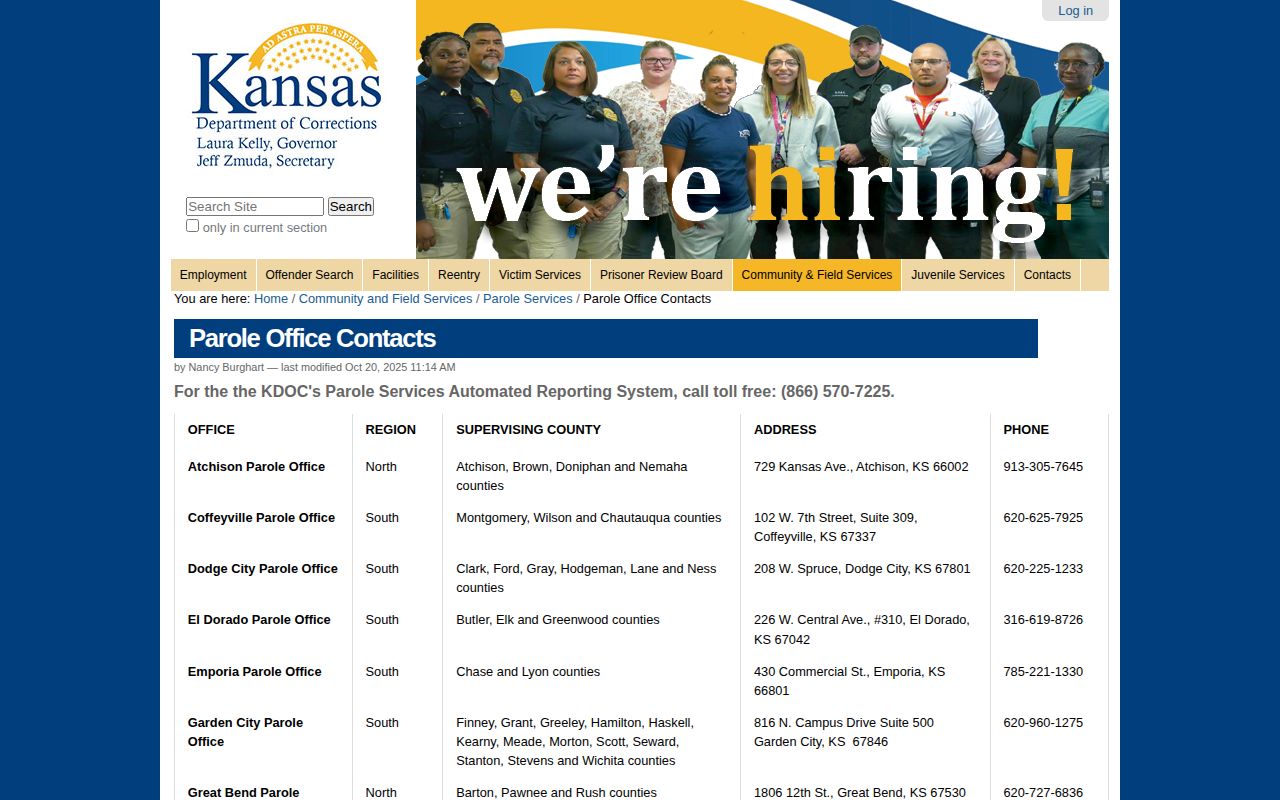
Use that assignment to confirm an active state-supervision record, while local probation questions stay with the Hiawatha community-corrections office.
Brown County Parole Hearing Records
The Kansas Prisoner Review Board handles parole decisions for eligible indeterminate cases, sets conditions for relevant releases, and addresses revocations. Its public-comment schedule and prospective listed-person material show future steps. They are not release results. A person normally appears before the Board in the month before eligibility, but eligibility means the Board may consider release. It does not mean release will occur.
Official process materials describe three basic outcomes. “Parole” means the Board found the resident suitable for release. “Continue” postpones a decision for more facts, votes, deliberation, or evaluation. “Pass” denies release for a stated period. A Full Board Review is a review posture, not a grant. No official public person-searchable database of PRB decisions or monthly result list was verified. After a hearing, check KASPER for a changed status or movement and contact PRB or KDOC for confirmation.
The Board's official process page defines these hearing outcomes.
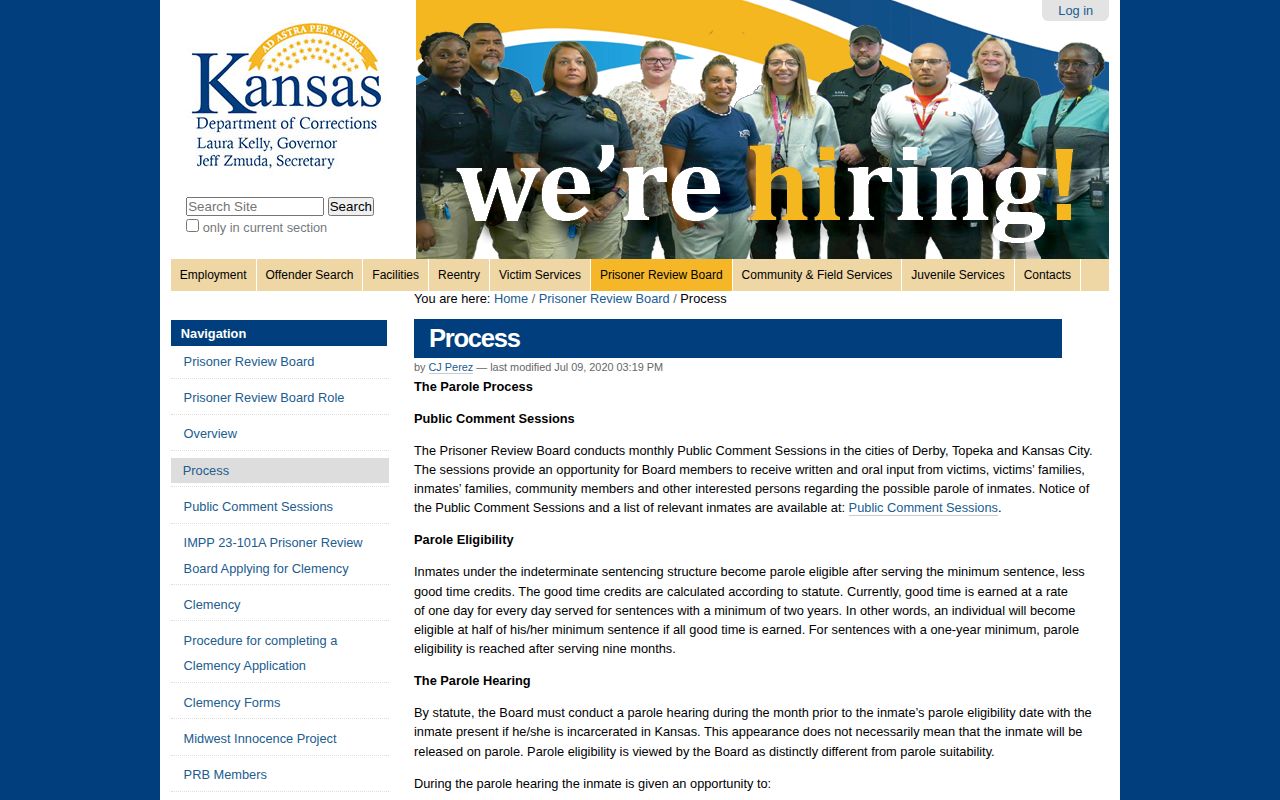
The process is the proper source for interpreting a decision term; a calendar entry remains only a future event.
Brown County Supervision Discharge
Release from a jail or prison comes before final discharge in many cases. A parolee or a person on mandatory postrelease has left confinement but remains under KDOC authority. A probationer remains subject to the sentencing court and the assigned supervision program. Violations can lead to a sanction or revocation, and revocation may return the person to confinement. For that reason, an old movement or notification cannot establish the person's current status.
For KDOC cases, read the maximum-sentence or discharge information and look for the KASPER supervision type “Discharged.” K.S.A. 22-3722 and KDOC process materials govern state discharge concepts. For probation, seek the court's discharge or termination order and verify it with the clerk or supervising program. The Brown County released-inmate search guide explains how the county release record and court disposition fit beside these supervision records.
Kansas open-records law does not guarantee access to every supervision document. K.S.A. 45-221 contains exemptions, and some Prisoner Review Board reports are privileged under K.S.A. 22-3711. Ask the record holder for the specific public field or document needed. If access is denied or redacted, request the legal basis rather than assuming the underlying supervision ended.
Use the latest dated entry. A prior parole-office assignment can remain in a record after a later movement, revocation, or discharge changes the responsible authority.